
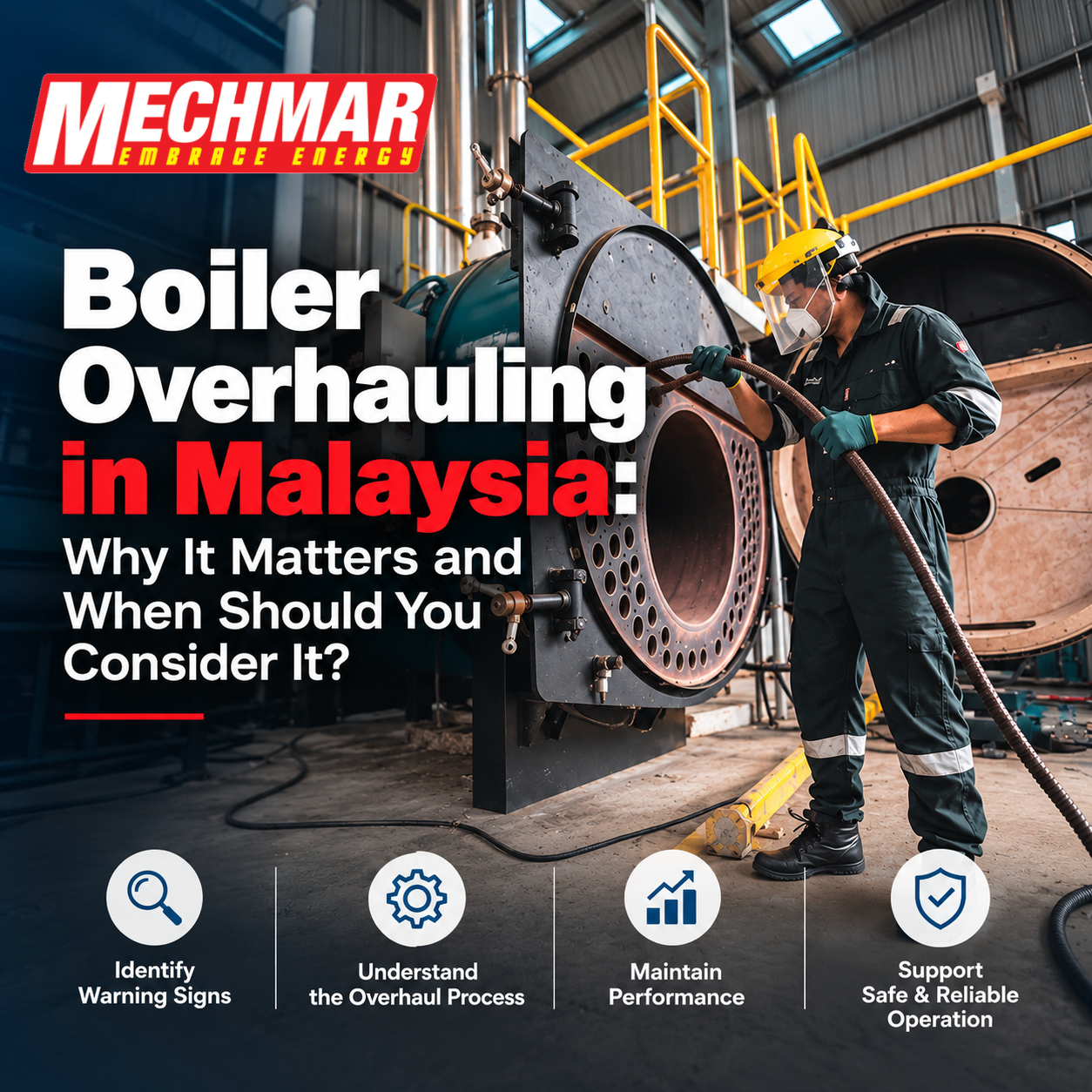
Boiler Overhauling in Malaysia: Why It Matters and When Should You Consider It?
Industrial steam boilers play an essential role in manufacturing operations, supplying steam for production, heating, processing and other industrial applications. From food processing and palm oil mills to chemical manufacturing and other industrial facilities, reliable steam generation is important for maintaining consistent operations.
But what happens when a boiler begins to lose performance, consume more fuel or experience recurring maintenance issues?
These changes may indicate that the boiler requires further inspection and, depending on its condition, a more comprehensive overhaul.
Boiler overhauling is a maintenance process involving the inspection, cleaning, servicing, repair and, where necessary, replacement of boiler components to help restore equipment condition and maintain safe, reliable operation.
For industrial boiler owners in Malaysia, understanding when overhauling may be necessary can support better maintenance planning, reduce the risk of unexpected downtime and help protect long-term equipment investments.
What Is Boiler Overhauling?
Boiler overhauling is a comprehensive maintenance activity that goes beyond routine operational checks and basic servicing.
It typically involves assessing the condition of important boiler components, identifying deterioration, removing deposits, carrying out necessary repairs and performing relevant tests before returning the equipment to service.
The exact scope depends on the boiler type, operating history, condition and inspection findings.
For example, an overhaul may involve:
-
Inspection of boiler tubes and pressure-retaining components.
-
Assessment of scaling, corrosion, erosion and other deterioration.
-
Cleaning of accessible heat transfer surfaces.
-
Inspection and servicing of applicable boiler fittings and safety devices.
-
Repair or replacement of defective components.
-
Reassembly and appropriate testing.
Boiler overhauling is relevant to both fire-tube boilers and water-tube boilers, although their construction and maintenance requirements differ.
The objective is not simply to repair existing defects, but to understand the equipment's condition and address identified maintenance needs.
Why Is Boiler Overhauling Important?
1. Reduce the Risk of Unexpected Boiler Failures
Industrial boilers operate under demanding conditions involving pressure, temperature and repeated operating cycles.
Over time, components may experience wear, corrosion, fouling or other forms of deterioration.
Without appropriate inspection and maintenance, some defects may progress and eventually contribute to equipment failures.
A properly planned boiler overhaul allows maintenance teams to assess component condition and identify issues that may require corrective action.
Addressing these issues can help reduce the risk of unplanned shutdowns and support more reliable steam production.
2. Help Maintain Boiler Efficiency
Boiler efficiency can be affected by several factors, including heat transfer surface cleanliness, combustion performance, water quality and operating conditions.
For example, mineral scale on water-side heat transfer surfaces can restrict heat transfer. Soot or other deposits on fireside surfaces can also reduce heat transfer effectiveness.
When heat transfer deteriorates, additional fuel may be required to produce the same useful steam output.
Appropriate cleaning, servicing and corrective maintenance may help restore lost performance, depending on the cause and condition of the boiler.
However, an overhaul does not automatically guarantee a particular efficiency improvement. Actual results depend on the issues identified and the work performed.
3. Support Boiler Safety and Regulatory Compliance
Steam boilers are pressure equipment that require careful operation, inspection and maintenance.
In Malaysia, applicable steam boilers are regulated under the Occupational Safety and Health Act 1994 and the Occupational Safety and Health (Plant Requiring Certificate of Fitness) Regulations 2024.
Boiler owners must ensure that relevant inspection, certification, competent-person and other applicable regulatory requirements are fulfilled.
Overhauling can support equipment condition and inspection readiness by addressing identified defects and maintenance requirements.
However, completing an overhaul does not, by itself, establish regulatory compliance or replace required inspections, approvals or certification.
4. Support Longer Equipment Service Life
Industrial boilers represent a significant capital investment.
Proper maintenance can help manage deterioration and support the continued serviceability of boiler components.
During an overhaul, inspection findings may identify components that require cleaning, repair or replacement.
By addressing these findings appropriately, boiler owners can make more informed decisions about maintenance, continued operation and future equipment replacement.
5 Warning Signs Your Boiler May Need Further Inspection
Not every operating issue means a complete overhaul is necessary.
However, certain changes should prompt further investigation.
1. Increasing Fuel Consumption
Is your boiler consuming more fuel even though steam demand has remained relatively consistent?
This may indicate reduced heat transfer effectiveness, combustion-related issues or other operating inefficiencies.
Potential causes should be investigated before deciding whether overhauling is required.
2. Recurring Boiler Defects
Repeated maintenance problems, including recurring leaks or component failures, may indicate underlying issues that have not been fully resolved.
A more comprehensive inspection may help identify the root cause.
3. Declining Steam Performance
Difficulty maintaining expected steam pressure or output can affect production processes.
Possible contributing factors include fouling, combustion problems, component deterioration or changes elsewhere in the steam system.
4. Evidence of Scaling, Corrosion or Tube Deterioration
Inspection findings such as excessive deposits, pitting, erosion or tube wall deterioration may indicate the need for cleaning, further assessment or corrective maintenance.
The appropriate action depends on the location, severity and nature of the defect.
5. Increasing Maintenance Frequency
If a boiler requires increasingly frequent corrective maintenance, it may be time to review its overall condition.
A structured condition assessment can help determine whether targeted repairs, additional servicing or a more extensive overhaul would be appropriate.
Important: These warning signs are indicators for investigation, not a definitive diagnosis that a boiler requires overhauling.
What Happens During an Industrial Boiler Overhaul?
A boiler overhaul generally follows a structured process, with the work scope determined by equipment condition and technical requirements.
Stage 1: Dismantling and Component Assessment
Following appropriate shutdown, isolation, cooling and safety preparations, relevant components may be opened or dismantled to provide inspection access.
Activities can include:
-
Inspection and assessment of boiler fittings.
-
Evaluation of boiler tubes for scaling, corrosion, pitting or erosion.
-
Non-destructive testing (NDT), where required.
-
Inspection of applicable burner and fuel system components.
-
Assessment of visible defects and component condition.
The findings help determine the necessary maintenance and repair work.
Stage 2: Cleaning and Descaling
Deposits can accumulate on boiler heat transfer surfaces over time.
Depending on the boiler design and condition, cleaning activities may include:
-
Mechanical tube cleaning.
-
Removal of soot and combustion deposits.
-
Descaling using an appropriate approved method.
-
Cleaning of accessible internal or external heat transfer surfaces.
The selected method must be suitable for the boiler's construction, materials and condition.
Stage 3: Repairs and Component Replacement
Where inspection identifies defective or deteriorated components, corrective work may be recommended.
Depending on the findings, this can include:
-
Boiler tube replacement or re-tubing.
-
Approved weld repairs.
-
Refractory and insulation repairs.
-
Servicing or replacement of valves and fittings.
-
Inspection, servicing and calibration of applicable safety devices.
Repair activities must follow relevant engineering procedures and regulatory requirements.
Stage 4: Reassembly and Testing
Following the completion of maintenance and repairs, the boiler is reassembled and relevant checks are performed.
Depending on the work scope, these may include:
-
Verification of reassembled components.
-
Applicable pressure or integrity testing.
-
Safety device checks.
-
Burner adjustment and combustion testing, where applicable.
-
Operational checks before return to service.
The required testing and approval process depends on the nature of the work and applicable requirements.
Fire-Tube vs Water-Tube Boiler Overhauling: Is There a Difference?
Both fire-tube and water-tube boilers require appropriate maintenance, but their design affects how inspection and overhaul work is carried out.
Fire-Tube Boilers
In a fire-tube boiler, hot combustion gases pass through tubes surrounded by water.
Overhauling may involve inspection and cleaning of fire tubes, assessment of the furnace and tube plates, checking for corrosion or deposits, and servicing associated components.
Water-Tube Boilers
In a water-tube boiler, water circulates through tubes that are heated externally by combustion gases.
Overhauling may involve inspection of water tubes, headers, drums and other accessible components, along with cleaning and assessment of tube condition.
The inspection and repair methods depend on the boiler's specific design and operating requirements.
Mechmar's After Sales Services (MASS) team provides overhauling services for both fire-tube and water-tube boilers.
When Should You Schedule a Boiler Overhaul?
There is no single overhaul interval suitable for every industrial boiler.
The appropriate timing depends on several factors:
-
Boiler design and manufacturer's recommendations.
-
Operating hours and duty cycle.
-
Fuel type and combustion conditions.
-
Feedwater quality and water treatment effectiveness.
-
Previous inspection and maintenance findings.
-
History of defects, repairs or component deterioration.
-
Applicable statutory inspection and maintenance requirements.
For factories operating continuously, it is beneficial to evaluate overhaul requirements ahead of a planned shutdown.
Early planning provides an opportunity to assess the required work scope, coordinate personnel, prepare necessary spare parts and manage the maintenance schedule.
Rather than waiting for a major failure, boiler owners should use operating records, inspection findings and competent technical advice to determine the appropriate maintenance action.
How Can Boiler Overhauling Help Reduce Downtime?
Unplanned boiler downtime can disrupt manufacturing schedules, affect production output and create additional maintenance costs.
While overhauling itself requires a planned maintenance period, identifying problems and addressing them during a scheduled shutdown may reduce the likelihood of certain unexpected failures later.
Effective preparation can include:
-
Reviewing previous inspection and maintenance reports.
-
Identifying known defects before the shutdown.
-
Confirming the proposed maintenance scope.
-
Preparing necessary spare parts and resources.
-
Coordinating testing and return-to-service requirements.
The duration of an overhaul depends on boiler condition, accessibility, work scope and any additional defects discovered during inspection.
Boiler Overhauling Services in Malaysia by Mechmar Boilers
At Mechmar Boilers Sdn Bhd, our Mechmar After Sales Services (MASS) team supports industrial customers with boiler maintenance and overhauling services.
Our service scope includes activities such as boiler component assessment, cleaning, inspection, repairs, component replacement recommendations and applicable testing.
We support both fire-tube and water-tube boiler systems, with maintenance requirements assessed according to the equipment's condition and operating needs.
Our approach emphasises appropriate technical assessment, practical maintenance planning and reliable operational outcomes.
Frequently Asked Questions About Boiler Overhauling
What is the difference between boiler servicing and boiler overhauling?
Routine boiler servicing generally involves scheduled checks, adjustments and maintenance activities. Boiler overhauling is usually more extensive and may include dismantling, detailed inspection, cleaning, repairs and component replacement, depending on the boiler's condition.
How often should an industrial boiler be overhauled?
There is no universal overhaul interval. The appropriate frequency depends on boiler design, operating conditions, manufacturer recommendations, inspection findings and maintenance history. Statutory inspection requirements must also be observed.
Can boiler overhauling improve efficiency?
Yes, overhauling may help restore efficiency where performance has deteriorated due to issues such as fouling, scaling or defective components. The actual improvement depends on the cause of the problem and the corrective work performed.
Is boiler overhauling required by DOSH in Malaysia?
Boiler owners must comply with applicable DOSH requirements for steam boiler operation, inspection, certification and relevant repair activities. Whether a particular overhaul is required depends on the boiler's condition, applicable obligations and inspection findings. An overhaul is not automatically required at every inspection.
How long does a boiler overhaul take?
The duration depends on the boiler type, size, condition and scope of work. Extensive repairs, replacement parts or additional testing may affect the schedule. A site assessment can help establish a more realistic maintenance plan.
Can both fire-tube and water-tube boilers be overhauled?
Yes. Both boiler types can undergo overhauling, although their construction, inspection access and maintenance procedures differ.
Conclusion: Don't Wait for a Breakdown to Assess Your Boiler's Condition
Boiler overhauling is more than a response to equipment failure. It is an important maintenance activity that can help industrial operators understand equipment condition, address deterioration and support reliable steam generation.
For boiler owners in Malaysia, the key is to recognise changes in performance, investigate their causes and plan appropriate maintenance before problems escalate.
Inspection first. Overhauling when necessary.
Need Advice on Your Boiler's Condition?
Whether you operate a fire-tube or water-tube boiler, Mechmar's After Sales Services team can assist with evaluating your boiler maintenance and overhauling requirements.
Contact Mechmar Boilers Sdn Bhd
Email: meg@mechmar.com.my
Call / WhatsApp: +60 18-281 1234
Plan your boiler maintenance with Mechmar Boilers.
More Content
Is Your Boiler Fuel Cost Increasing? Consider a Burner Conversion
Rising fuel costs and recurring burner problems can affect boiler performance. Learn when to...
Boiler Overhauling in Malaysia: Why It Matters and When Should You Consider It?
Boiler overhauling is an important part of industrial steam boiler maintenance. Discover the...
Actual Steam Capacity vs From & At 100°C: Understanding Boiler Steam Capacity
Why does your boiler's actual steam output differ from the catalogue...
Is Your Boiler Still Compliant? What OSHA 2024 Means for Boiler Owners in...
Operating a steam boiler in Malaysia comes with specific safety and regulatory requirements....
The True Cost of Skipping Boiler Maintenance: Downtime, DOSH Fines & Safety...
Boiler maintenance is essential for ensuring operational reliability, regulatory compliance, and...
Boiler Re-Tubing: Prevent Costly Boiler Downtime with Early Tube Replacement
Learn how early boiler re-tubing prevents costly breakdowns, improves boiler efficiency, extends...
Dual Fuel Burner Conversion: Improve Reliability, Reduce Risk, and Gain Fuel...
Learn how dual fuel burner conversion enables industrial facilities to switch between diesel and...
Is Your Boiler Silently Draining Your Profits? Here's What Every Plant Manager...
Small boiler inefficiencies often go unnoticed—but they can have a significant impact on...
Why Two Economisers Can Look Identical but Perform Completely Differently
Many boiler owners compare economisers based on size, capacity or price. However, the true...
Titan MB 4-Pass Boiler – Higher Efficiency, Lower Fuel Consumption, Greater...
Learn how the Mechmar Titan MB 4-Pass Boiler improves thermal efficiency, reduces fuel...
The Complete Boiler Maintenance Checklist for Palm Oil Mills
A practical guide for palm oil mill engineers covering daily inspections, preventive...
Why Bi Drum Boilers Are Critical for Efficient Palm Oil Mill Operations
A complete guide on how bi drum boilers support palm oil mill operations through efficient steam...
What Is a Once-Through Steam Boiler? Benefits, Applications & Why Industries...
Learn how once-through steam boilers help factories reduce downtime, improve energy efficiency,...
Burner Service & Combustion Tuning: The Smartest Way to Reduce Boiler Fuel Cost...
Learn why burner service and combustion tuning are essential for improving boiler efficiency,...
Palm Oil Mill Boilers: Choosing the Right Biomass Boiler for Reliable Steam...
Discover how biomass boilers improve efficiency, reduce fuel costs and support sustainable palm...
How Mechmar Supports Malaysia’s Food & Beverage Industry
Reliable steam boiler solutions supporting food safety, production consistency and energy...
Boiler Maintenance for Food & Beverage Industry in Malaysia: Why It Matters
A practical guide for food manufacturers on why boiler maintenance is critical to ensure...
Top 5 Boiler Problems in Food Factories (and How to Avoid Them)
A practical guide to the most common boiler problems in food factories and how to prevent costly...
Boiler Retubing in Malaysia: Restore Efficiency & Extend Boiler Lifespan
Boiler retubing is a critical maintenance solution to restore efficiency, reduce fuel costs, and...
2026 Carbon Tax: Is Your Boiler Operation Ready?
An educational insight on how the upcoming 2026 Carbon Tax impacts boiler operations, fuel...
Rental Boiler Solutions in Malaysia – Stay Powered, Stay Productive
Mechmar’s Rental Boiler Initiative provides flexible, reliable, and fast-deployment steam...
Safeguards for Fire Tube Boilers: Critical Safety Systems Explained
A comprehensive technical guide on the essential controls and safety devices required to keep...
Powering Palm Oil Mills Across Central America With Mechmar Boilers
Learn how Mechmar Boilers delivered a high-efficiency 25-ton bi-drum water tube boiler for palm...
Free Boiler Health Checkup in Malaysia – Industrial Boiler Inspection by...
Get a complimentary industrial boiler inspection by Mechmar. Includes performance, safety, and...
Boiler Critical Spare Parts – Your Assurance of Uninterrupted Performance
Keep your industrial boiler performing at peak efficiency with genuine critical spare parts from...
4 Reasons Why the Reverse-Flame 3-Pass Steam Boiler Outperforms Conventional...
An educational article highlighting the advantages of Mechmar’s Reverse-Flame 3-Pass Steam...
5 Key Indicators It’s Time to Upgrade Your Industrial Boiler
A comprehensive guide on the five most important indicators that signal it’s time to...
Modernize Your Boiler with Zero Upfront Investment
Discover BoilerCare, the service program that allows Malaysian industries to upgrade boiler...
Boiler Feed Water Piping Fabrication Process: 8 Critical Steps for Reliable...
An in-depth guide to the boiler feed water piping fabrication process and why precision...