
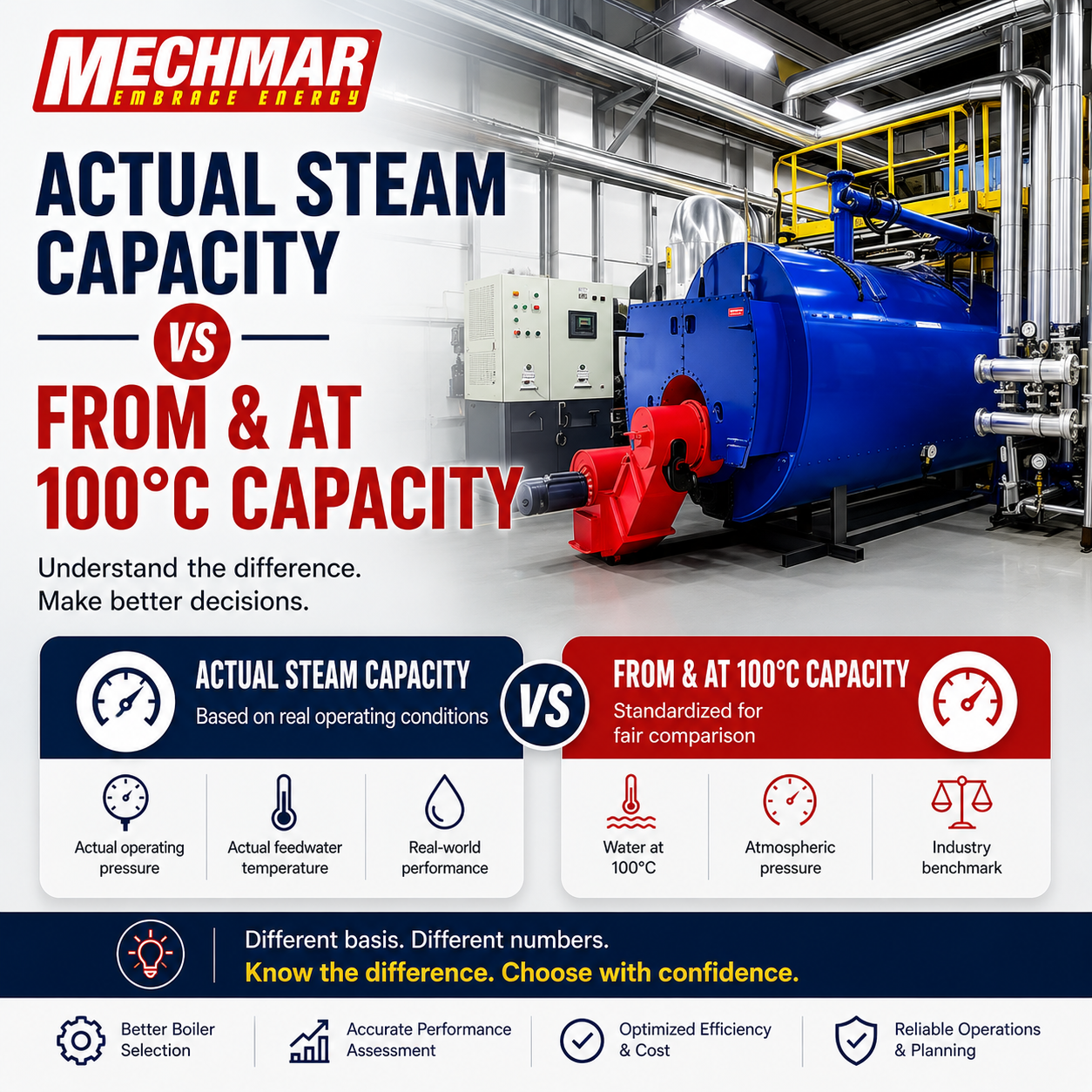
Actual Steam Capacity vs From & At 100°C: What's the Difference?
1. What Is Actual Steam Capacity?
- Operating pressure
- Saturated steam temperature
- Feedwater inlet temperature
- Actual plant operating conditions
2. What Is Steam Capacity From & At 100°C?
- Feedwater starts at 100°C
- The water is converted into saturated steam at 100°C
- The reference condition is approximately atmospheric pressure
Actual capacity tells you what the boiler produces under its operating conditions.
From & At 100°C capacity gives you a standardized basis for comparison.
3. Actual Steam Capacity vs From & At 100°C
|
Feature |
Actual Steam Capacity |
From & At 100°C Capacity |
|
Basis |
Actual operating conditions |
Standardized reference conditions |
|
Operating pressure |
Based on actual boiler pressure |
Standardized to atmospheric reference conditions |
|
Steam temperature |
Saturation temperature corresponding to operating pressure |
Standardized to 100°C |
|
Feedwater |
Based on actual inlet temperature |
Assumes water starts at 100°C |
|
Purpose |
Assess real-world plant performance |
Compare boiler capacities on a common basis |
4. Why Is the Actual Steam Output Lower?
Step 1 — Heat the feedwater
Step 2 — Convert water into steam
5. Why Does From & At 100°C Show a Higher Capacity?
6. How Is Steam Capacity Converted?
7. Why Does the Factor of Evaporation Matter?
- Comparing boiler specifications
- Reviewing boiler performance
- Evaluating steam requirements
- Assessing boiler capacity
- Comparing different boiler models
- Reviewing existing plant performance
8. Which Steam Capacity Should You Use?
From & At 100°C = standardized comparison
Actual Steam Capacity = real operating conditions
9. Why This Matters When Selecting a Boiler
10. A Simple Way to Remember It
FROM & AT 100°C
The Key Takeaway
The catalogue number and the actual steam output are not necessarily the same thing.
Frequently Asked Questions
- Actual steam capacity is the amount of steam a boiler produces under its specific operating conditions, including its operating pressure and feedwater conditions.
- From & At 100°C is a standardized basis for expressing steam capacity. It provides a common reference for comparing boilers operating under different conditions.
- Under actual conditions, the boiler must first use energy to heat the feedwater to its boiling point before converting it into steam. The From & At 100°C basis assumes the water is already at 100°C.
- The Factor of Evaporation (FE) is used to convert actual steam generation into an equivalent steam capacity on a From & At 100°C basis.
- It provides a common reference condition, making it easier to compare steam capacities between boilers operating at different pressures and feedwater temperatures.
- Yes. Boiler capacity requirements depend on the application's operating conditions and steam demand. Contact Mechmar's boiler specialists to discuss your steam requirements and application.
Need Help With Your Boiler Capacity?
Call / WhatsApp: +60 18-281 1234
Email: meg@mechmar.com.my
More Content
Actual Steam Capacity vs From & At 100°C: Understanding Boiler Steam Capacity
Why does your boiler's actual steam output differ from the catalogue...
Boiler Re-Tubing: Prevent Costly Boiler Downtime with Early Tube Replacement
Learn how early boiler re-tubing prevents costly breakdowns, improves boiler efficiency, extends...
The True Cost of Skipping Boiler Maintenance: Downtime, DOSH Fines & Safety...
Boiler maintenance is essential for ensuring operational reliability, regulatory compliance, and...
Dual Fuel Burner Conversion: Improve Reliability, Reduce Risk, and Gain Fuel...
Learn how dual fuel burner conversion enables industrial facilities to switch between diesel and...
How a Pre-Assembled Fire Tube Boiler Reduced Installation Time from 3 Months to...
When a regional energy company required additional steam capacity, minimizing on-site...
Is Your Boiler Silently Draining Your Profits? Here's What Every Plant Manager...
Small boiler inefficiencies often go unnoticed—but they can have a significant impact on...
Why Two Economisers Can Look Identical but Perform Completely Differently
Many boiler owners compare economisers based on size, capacity or price. However, the true...
Titan MB 4-Pass Boiler – Higher Efficiency, Lower Fuel Consumption, Greater...
Learn how the Mechmar Titan MB 4-Pass Boiler improves thermal efficiency, reduces fuel...
The Complete Boiler Maintenance Checklist for Palm Oil Mills
A practical guide for palm oil mill engineers covering daily inspections, preventive...
20 TPH Bi-Drum Biomass Boiler Successfully Installed and Ready for...
Another successful international project milestone by Mechmar Boilers. A 20 TPH Bi-Drum Biomass...
Why Bi Drum Boilers Are Critical for Efficient Palm Oil Mill Operations
A complete guide on how bi drum boilers support palm oil mill operations through efficient steam...
What Is a Once-Through Steam Boiler? Benefits, Applications & Why Industries...
Learn how once-through steam boilers help factories reduce downtime, improve energy efficiency,...
Burner Service & Combustion Tuning: The Smartest Way to Reduce Boiler Fuel Cost...
Learn why burner service and combustion tuning are essential for improving boiler efficiency,...
Palm Oil Mill Boilers: Choosing the Right Biomass Boiler for Reliable Steam...
Discover how biomass boilers improve efficiency, reduce fuel costs and support sustainable palm...
How Mechmar Supports Malaysia’s Food & Beverage Industry
Reliable steam boiler solutions supporting food safety, production consistency and energy...
Boiler Maintenance for Food & Beverage Industry in Malaysia: Why It Matters
A practical guide for food manufacturers on why boiler maintenance is critical to ensure...
Top 5 Boiler Problems in Food Factories (and How to Avoid Them)
A practical guide to the most common boiler problems in food factories and how to prevent costly...
Boiler Retubing in Malaysia: Restore Efficiency & Extend Boiler Lifespan
Boiler retubing is a critical maintenance solution to restore efficiency, reduce fuel costs, and...
2026 Carbon Tax: Is Your Boiler Operation Ready?
An educational insight on how the upcoming 2026 Carbon Tax impacts boiler operations, fuel...
Rental Boiler Solutions in Malaysia – Stay Powered, Stay Productive
Mechmar’s Rental Boiler Initiative provides flexible, reliable, and fast-deployment steam...
Safeguards for Fire Tube Boilers: Critical Safety Systems Explained
A comprehensive technical guide on the essential controls and safety devices required to keep...
Powering Palm Oil Mills Across Central America With Mechmar Boilers
Learn how Mechmar Boilers delivered a high-efficiency 25-ton bi-drum water tube boiler for palm...
Free Boiler Health Checkup in Malaysia – Industrial Boiler Inspection by...
Get a complimentary industrial boiler inspection by Mechmar. Includes performance, safety, and...
Boiler Critical Spare Parts – Your Assurance of Uninterrupted Performance
Keep your industrial boiler performing at peak efficiency with genuine critical spare parts from...
4 Reasons Why the Reverse-Flame 3-Pass Steam Boiler Outperforms Conventional...
An educational article highlighting the advantages of Mechmar’s Reverse-Flame 3-Pass Steam...
5 Key Indicators It’s Time to Upgrade Your Industrial Boiler
A comprehensive guide on the five most important indicators that signal it’s time to...
Modernize Your Boiler with Zero Upfront Investment
Discover BoilerCare, the service program that allows Malaysian industries to upgrade boiler...
Boiler Feed Water Piping Fabrication Process: 8 Critical Steps for Reliable...
An in-depth guide to the boiler feed water piping fabrication process and why precision...
PROJECT FUTUREREADY: An Industry Dialogue on the Future of Boiler Operations in...
Project FutureReady is an industry dialogue for senior decision-makers from industrial...